by admin | Oct 8, 2026 | Articles, Newsletter
I have been thinking seriously for some time about being an Earthling. Laurel and Edwin have encouraged me to write about it. I was also encouraged along the way by none other than Germaine Greer. During her appearance on Julia Zemiro’s Home Delivery, she rejected being labelled with any specific national home, declaring instead, “I am an Earthling.” ‘Yes’, I thought, ‘that’s what I am’. I wonder if my reasons for thinking about myself this way are the same as hers.
It is not that I want to depreciate or deprecate in any way that I live in Australia, that I am an Australian. On the contrary. It is a wonderful country; I am very pleased to live here. That’s it really; I live here. It is not who I am in an ultimately defining sense. My sense of identity is searching for something deeper, bigger. I did play for a while with thinking of myself as an Anglo-Celt, that this was my ‘indigenaity’. My grandfather came out from Scotland in the 1880’s. It is true that I have appreciated getting more in touch with my racial roots in my old age. In 2015 my family attended a Gathering of the Clans in Scotland, followed by a conference of the Oliphant Clan at which I met Oliphant’s from around the world, especially North America. But the deal was clinched when I learnt that two of my daughters have the ‘Celtic curse’, Hemochromatosis. It is primarily caused by a mutation in the HFE gene, which disrupts the body’s ability to regulate iron absorption from food. It is exceptionally common in people of Celtic, Irish, Scottish, Welsh, and Northern European descent.
Strangely enough, emotionally connecting with my Celtic roots opened my heart to how important ‘being aboriginal’ is to First Nation people in Australia. I began to not just acknowledge this with my ‘head’, I felt it. Landscape or Country does identify us somehow. Something moves me in the landscape of northern Scotland, and Britain generally, in a way that is a bit different to the ways the landscape moves me in Australia. Both are fundamentally important, but the first time I drove through the British countryside I ‘teared up’ with the thought I had ‘come home’.
Something runs deep here, but nonetheless my search for a sense of identity was still somehow not yet quite satisfied. ‘The issue’ a friend said to me ‘is what it really means to be a human being’. A human being! Of course, we are all ‘human beings’. This is true, but why doesn’t it help all that much I wondered. I am a human being! It is not so much a sense of personal identity as a description of who I am that separates me from other creatures. Given that there was a time when we were not on this little planet, before homo sapiens had evolved, being a ‘human being’ does differentiate me in terms of ‘time’, while also connecting me with all other creatures who are ‘human beings’; but not strongly perhaps and not for long. We quickly revert to being ‘male’, or ‘female’, or ‘transgender’, to being an American, or Russian or Australian, or a Canberran or a Londoner or a New Yorker, or a Carlton supporter or a South Sydney fan or whatever. The problem with ‘human being’ is it is indeterminate with regard to ‘place’. I think that’s it. I think a sense of place makes all the difference for a sense of personal identity.
I somehow knew this before I knew I knew it. I have told the story before of picking up my youngest daughter, who is now a middle-aged woman, from primary school when she was less than ten. Her class had watched a video of Planet Earth taken from space. As she watched, the thought had come to her that she was down there somewhere, running around. I was amazed. She was standing outside the place that gave her her existence, her being, her ‘home’, and seeing it over and against her in genuine photographic images which no doubt she was also internalising. At the same time she was also imagining herself in her ‘mind’s eye’ as ‘down there’ somewhere. This surely was a very significant shift of consciousness. It was as if her imagination could take the photographs and use them to project herself in her ‘mind’s eye’ into space and there to ‘see’ or ‘look at’ the planet, and herself, from space.
I remembered the time when I first read that the British astronomer Fred Hoyle, as early as 1948, had famously written: “Once a photograph of the Earth, taken from outside, is available… a new idea as powerful as any in history will be let loose”. In his 1950 book The Nature of the Universe, Hoyle argued that seeing our world in its sheer cosmic isolation would fundamentally shift human consciousness. I had been very taken with this. This had happened to my daughter, it would seem, to some degree, spontaneously. Could this happen to me, intentionally?
Such photographs came to pass when the iconic Earthrise image captured by the Apollo 8 astronauts in 1968, followed by the 1972 Apollo 17 Blue Marble photo, were published. Many other photos have followed. However, it was not only the actual photographs that caught my attention; it was also the experiences of the astronauts themselves at the time. One aspect of those experiences has been called the ‘overview effect’.
The overview effect is a cognitive shift reported by some astronauts while viewing the Earth from space. Researchers have characterised the effect as “a state of awe with self-transcendent qualities, precipitated by a particularly striking visual stimulus”. The most prominent common aspects of personally experiencing the Earth from space are appreciation and perception of beauty, unexpected and even overwhelming emotion, and an increased sense of connection to other people and the Earth as a whole. The effect can cause changes in the observer’s self concept and value system, and can be transformative. Immersive virtual reality simulations have been designed to try to induce the overview effect in earthbound participants. (Wikipedia)

Earthrise

The Blue Marble
I could relate to this ‘overview effect’, to some degree, or so I thought, from my own experiences. I wondered if it was like ‘seeing’ something for the first time that had been looked at many times before, but never really seen. In the moment I actually ‘see’ that something it is a particular and not just an example of something general. I don’t dismiss it in its generality as I so often do, I stop and am taken by its particularity. I sense its presence. I enjoy to do that regularly with what I can see from my window or when I am walking in nature. The secret is not to analyse it in any way, or even to name it, but to just take it in and let it ‘speak’, let it reveal itself. This is in fact the basis of the science advocated by the great German thinker and playwright Goethe.
It is a science based on relationship rather than objectivity. When we give anything or anyone its ‘being’, its presence, an idea can be awoken within us that we can ‘feed’ on and respond to in our imagination. It is an affirmation of spirit rather than its negation. It is a sense of participation in the world around us. The breeze in the trees becomes life and spirit within me. Both my thoughts and my feelings are engaged. I experience this directly. Rightly or wrongly I take it that this is an experience similar to the First Nations’ experience of country and dadirri. It is about felt relationship and what converses between us. I am investing something personal and relational in my own planet, much as the ancients invested something personal and relational in the Sun and the stars. It was just such a sense of relationship with the Sun that led Copernicus, and also Kepler, to devoutly think about the Earth and the solar system from the point of view of the Sun, as if they were standing on it; and they went from such personal imagination of wonder to mathematical science from this new perspective. A great shift of consciousness heralded the modern world and changed us all.
But now in our time a further shift has occurred, and we need to catch up with it. Now human beings can not only just imagine being in space as Copernicus and Kepler did, we have actually been in space, and have photos to prove it. This very year we have even seen the far side of the moon, something never seen by a human being before, and we have all been invited to directly share in this experience, if we can let ourselves be so represented. When the crew of Artemis II first spoke to the gathered crowd after their splash-down, having just seen what no human being had ever seen before, the other side of the Moon, the Mission Specialist, Jeremy Hanson, in finishing his words, said: “I would suggest to you that when you look up here, you’re not looking at us. We are a mirror reflecting you. And if you like what you see, then just look a little deeper. This is you”.
‘This is you’. The overview effect was still strongly at work within him, I would suggest, and he was clearly experiencing a sense of representing us in what he had experienced. It was our experience as much as his, if we can believe that? I can. I want to. That planet, ‘down there’ is where I am running around and it is my home. I am an Earthling. I can stand outside myself and the place where I come from, and imagine the whole human story before me on that little planet to which I belong. I can in my own faltering way grasp the ‘Whole’, in both time and space, however the details might be progressively filled in.
Google AI tells me that the word ‘Earthling’ was first recorded in 1593 by the English writer Thomas Nashe in his pamphlet Christ’s Tears Over Jerusalem. In the 1590s, the word was a religious and philosophical term used to describe mortal, physical humans tied to the dirt, contrasting them with God and angels in heaven. An older related Old English word, yrþling or eorþling, meant a “plowman” or farmer, but the modern re-formation meaning an inhabitant of Earth appeared in the late 16th century. The modern planetary meaning, contrasting humans with space aliens, was popularised later in science fiction.
In other words in being an Earthling I can imagine myself to be an alien to myself and think and imagine the whole human Story, from the Big Bang to wherever and whenever we may be heading, a Story that I am both outside and viewing in my imagination, and yet at the same time part of, along with every one else. I am held by the ‘Whole’. We all are, but most of us don’t realise it. Saying I am an Earthling for me is not being ‘cute’. It is asserting a sense of identity that includes both a sense of place and a sense of time, and is entirely inclusive. And it is a Big Story. It is a shift of consciousness. It is a Becoming. It is a commitment. I will be working at it for the rest of my life.
I remember once sometime ago fantasising that it would be a good thing if all our world leaders were bundled into a spacecraft and taken into space to witness Blue Marble and Earthrise for themselves, to really ‘see’ our planet in its ‘cosmic isolation’ and experience the ‘overview effect’ for themselves, to understand the fundamental importance of wanting to be Earthlings for the sake of our planetary Home. The time has surely come that this sense of identity needs to touch us all if we are going to “beat ‘our’ swords into plowshares, and ‘our’ spears into pruning hooks; and nation not lift up sword against nation, and neither learn war anymore” (Isaiah 2:4, Micah 4:3). We are all Earthlings; we just have to know it and live it.
David Oliphant
October 2026
by admin | Oct 8, 2026 | Newsletter, Poetry
Hanging like a dew drop on the bush
Two pearls, iridescent in the morning sun.
Shivering gently with the awakening breeze
That cause goose bumps on the unwary skin.
But what of these two pearls that hang
reflecting in their glory?
God made them.
And for a time, they shine together,
Then disappear in the morning sun.
However – they will be back again tomorrow.
Br Edwin Thomas Lloyd-Jones 1995

Photo by Debbie Osiecki. Visit Debbie on Facebook or Instagram.
by admin | Oct 8, 2026 | Encouragement Grants, Newsletter
The Trust’s Encouragement Grant was established in 2021 in response to COVID-19 impacts on Australian communities and individuals. The grant is a one-off payment of up to $2,000 to support creative projects, or new ventures in their initial stages of development, that align with the principles of the charity. Its aim is to ‘encourage’ people to begin or further develop a project they might not otherwise be able to. The grant may also provide the applicant with links to an appropriate source for mentoring to enable greater progress and success.
Supported projects include, but are not limited to, those in the areas of:
- art, music and creative skills (especially in the young and in marginalised groups)
- spiritual values focusing upon hope, compassion and action
- raising of awareness and education in caring for our planet
- improving health outcomes (both physical and mental)
- supportive programs for Indigenous community members, the aged, disabled, and the marginalised.
To apply for a grant please go to this page on our website.
by admin | Oct 8, 2026 | Newsletter
It was a joy to me to visit the actual Elm Grove Sanctuary, for the very first time recently. I had first read the Elm Grove Story when it came out a number of years ago. Before long David Oliphant, my husband, and I joined in monthly group sharing of a meal, fellowship and meditation with Edwin and Laurel. These took place on the far South Coast of NSW with people interested in reflecting on their story too. I served on the NEST committee with its work in the Narooma High School and yet in all these years I had never myself been to the actual Elm Grove Sanctuary that was also named a ‘Centre of Hope’.
Excitement has been in the air since Peter and Sarah Swan, the latest stewards of the Elm Grove property, are now lovingly renewing the place with their children, Charlie and Ella. The Swans are orienting toward their own purpose and calling which seems quite similar to the way Laurel and Ed were guided there in the 1980’s. David and I are delighted now to have met Sarah and Pete personally with their friends and extended family. There’s nothing like face to face!
Everyone warmly welcomed us. I picked up a real sense of ease. God’s goodness and Presence, bigger than ourselves, is undoubtedly here. This was the occasion of Sarah and Pete’s Induction as Little Followers of Saint Francis in the lovingly hand built, stone Chapel, nestled below the original house on the hill. It is currently being bestowed with TLC.
Making our way to Elm Grove from Tumut, NSW, was breathtaking. David and I drove through the picturesque green valley with its National park all around the Goobarragandra River flowing through. The Elm Grove Sanctuary site sits on sacred ground to the Walgalu people who have cared for this country for thousands of years.
We stayed in the mud brick octagonal house, Bahloo meaning ‘moon’, (the Aboriginal name for the River running into the Goobarragandra River at Elm Grove. Both of these rivers later become the great Murrumbidgee). Bahloo was lovingly built and designed by Edwin, Laurel and friends. Its shape invites a central circle of equal sharing within.

The first Friday evening fed my soul with deeply beautiful, expressive musicians playing in the room, both young and old. Laurel had amazingly cooked the delicious food and brought it there.

The children decorated cup cakes for tomorrow.

Breakfast time on Saturday. We were able to connect with Peter and Krista Sands in Hobart by phone. They were following the whole weekend keenly, and were with us very much in spirit. Below is a photo of Peter’s special tree standing out beautifully from our breakfast window. There’s a story there!


How magical then to climb the hill to where the Chapel sits under the original home where Ed and Laurel, Michael and Rita lived and worked together. Michael fondly gave us a special tour.

From this vantage point we could breathe the fresh, clean air, and see the curves like two bosoms funnelling the Bahloo River into the Goobarragandra River, a most significant junction of the waters. This place is of great importance to the Aboriginal people, especially the women.


Many connections were made at the scrumptious morning tea outdoors which followed the Chapel service. Further meaningful encounters took place throughout the day. I very much enjoyed meeting Therese, Pete’s mother. We both value Pastoral Care.

All photos above by Angela Young.
Later a group of us walked down to the natural chapel in amongst the Elm Grove trees right next to the River. This is the very place where Michael and the late Rita Reid were married all those years ago.
The Goobarragandra River feels alive. Its musical flow spoke the language to me of health, healing and refreshment.

There we sat on logs to ponder in the gentle sunshine, to reminisce and share also with Blair and Rhonda Montague-Drake who were delighted to return to this special place for this meaningful celebration. We were so delighted to meet them and gain a further sense of the journey of Elm Grove since Laurel and Edwin had to leave it to downsize, those many years ago.


Photos by Michael Reid.
David and I made our way to Canberra early on Sunday morning to visit a sick relative. Our friends at Elm Grove promised to pray. I felt nurtured and ministered to both by their friendship and by the comfort of being in that beautiful cradle of nature itself. A renewed sense of purpose, love, care and community connection is gently and steadily growing there, in the Spirit.
I want to express my deep gratitude for the love, the joy and peacefulness; for the patience, kindness and goodness, faithfulness and discipline that is blossoming here.
God bless Elm Grove.
by admin | Oct 8, 2026 | Newsletter, Poetry

I like Spring because flowers bloom,
And sunshine fills the sky.
The little birds go chirp, chirp, chirp,
As they fly up high.
At the campground I can see
Bluebells dancing in the breeze.
And jasmine grows upon the vine
Near the chapel trees.
Spring is bright and warm and new,
With colours everywhere.
I love Spring because it shows
God’s love and wonderful care.
By Ella Swan
by Laurel Lloyd-Jones | Oct 8, 2026 | Nature & Spirituality, Newsletter
As we all experience the delights of Spring after Winter, we see how creation renews and restores hope through such beauty and promise. The gold of the wattle heralds its arrival and all of nature rejoices with bird song, bursting buds, fledglings and nature’s energies bubbling up around and within us.
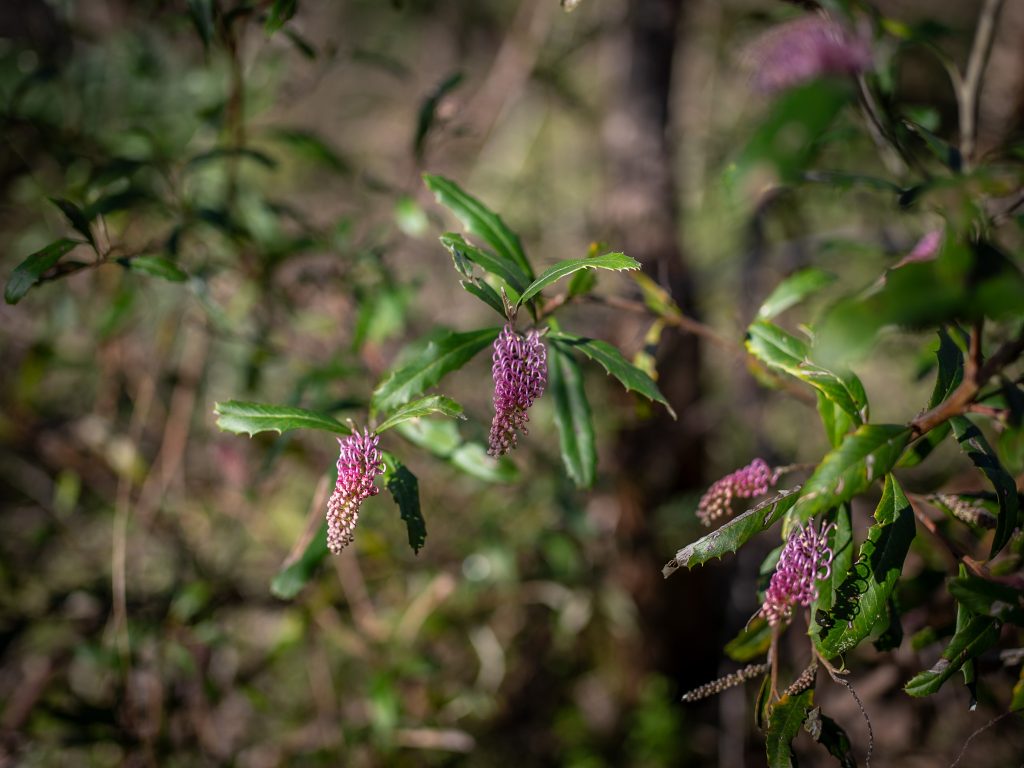
The critically endangered Tumut Grevillia at Elm Grove Sanctuary. Photo by Michael Reid.
And yet, in reality we also see the chaos and suffering of our world that is the result of our increasingly unstable world both politically and environmentally. A world that has seemingly lost its way and its connection to our natural world, our humanity and our Creator.
In reflecting on what is occurring at Elm Grove at this time I find there is a renewal of hope and purpose that will restore the vision that was given to Edwin and me from its founding back in 1983. I find such deep inner gratitude and acknowledgement that a Greater Plan is now renewing that sacred space and leading it into the future. Such places of sanctuary, rest and solace are so needed at this time and my deep joy has come from the wonderful commitment and restoration work that has been unfolding with Elm Grove’s new stewards, Sarah and Pete Swan, who are open on the inner heart-level of inner listening and Divine direction.
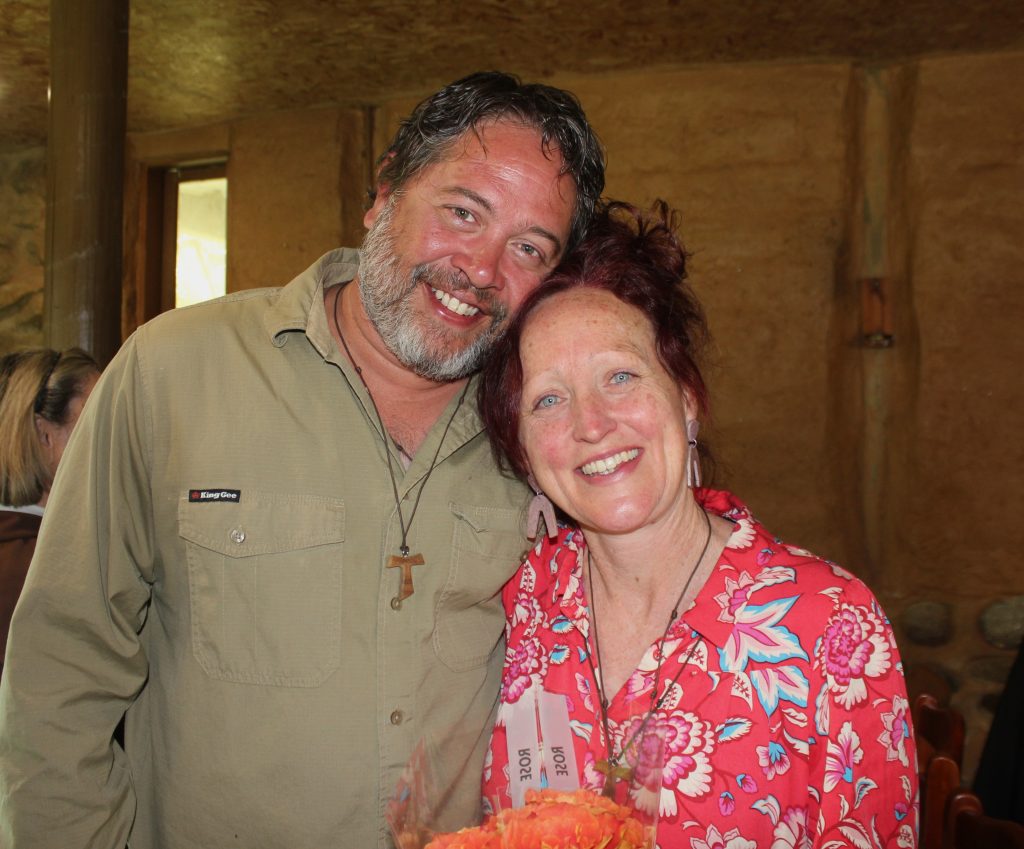
Pete and Sarah Swan. Photo by Blair Montague-Drake.
On Saturday, 19th September, 2026 Sarah and Pete were Inducted as Companions of our Franciscan Order, the Little Followers of Saint Francis (LFSF). Their request to become more formally aligned with the Franciscan ethos and charism that acknowledges the Divinity of all Creation, was a time of rejoicing and was shared by our wider Franciscan Community along with their family and friends. I hope that you will enjoy the photos of this wonderful event in this edition.
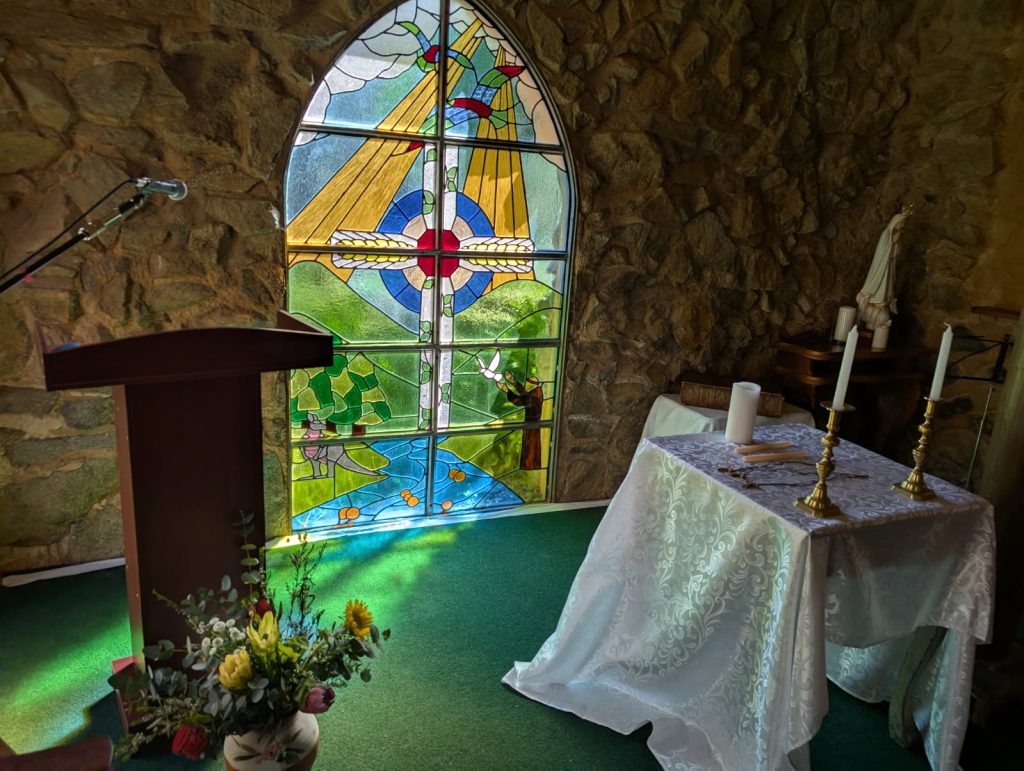
The St. Clare Chapel. Photo by Angela Young.

Sr Laurel, Pete and Sarah Swan. Photo by Blair Montague-Drake.
Our charity’s Board of Directors are returning to Elm Grove for our Annual General Meeting on 17th October, and we are all holding in discernment the important transition occurring that re-connects us back in loving support of the ‘Swans of Elm Grove’. Sarah and Pete will bring to the Sanctuary their own unique inspiration, giftedness and focus for the future. We are feeling such deep joy as we know that God’s Promise has been fulfilled by them saying ‘yes’ to a Higher Calling and we acknowledge their courage and commitment to take on this task.
Sarah and Pete, will assuredly place their own unique imprint on that sacred space with the guidance that comes from their own deep inner listening. I feel sure that the distinct clarity that led us to found Elm Grove, revealed to us through prayer and discernment, is such a powerful spiritual energy of love that brings amazement, awe and deep trust and that will inspire them to go forward despite the challenges that will come. When we work with love and complete trust in being led to act for a higher purpose, we can experience our fears vanishing.

Ella and Charlie Swan offered readings during the service. Photo by Blair Montague-Drake.
They have made a definitive statement by aligning their lives to the Franciscan charism to care for the earth. Pete and Sarah have not only become Carers for God’s Chosen Place – ‘hallowed ground’ – they acknowledge the significance of this sacred place for the Walgalu people. Long before us Europeans came to greatly honour and love it as a special place, it was and remains especially sacred for all Walgalu women. Above where the Bahloo River joins the Goobarragandra River is their sacred birthing place and it is their place of ceremony.
Over the many years from the founding of Elm Grove Sanctuary as a place of rest, solace and healing for weary souls, so many wonderful times were shared in happy and enthusiastic shared work as well as renewal. We collectively created environmentally responsible buildings to accommodate those who came to stay. We shared the joy of creating this centre of Hope. Right from our initial fun ‘muddie’ experiences, we formed the bricks together and then actually lifted those bricks to firstly build the St. Clare Chapel and then Bahloo Cottage, primarily for those who were referred for counselling, support and loving care.
This commitment and participation sank deeply into those lovely creative helpers over those years, and I see how this has been sustained within their memories and hearts. People continue to express their longing to return to spend time for reflection and inner peace and I am sure that when Sarah and Pete have reached the stage to again welcome guests back ‘home’ to that heart-space with sufficient accommodation and facilities, then this will bring much joy to many old sojourners and also new discoverers. Such places are so needed at this time.
If there are people who can offer their carpentry skills, gardening assistance etc to Pete and Sarah in this restoration work, then please do make contact with them and offer your help. Pete’s email is pete.swan@gmail.com.
With our recent return to Elm Grove for Sarah and Pete’s induction as Companions of LFSF a still moment by the river brought me back to the reading from Ezekial 47 on the ‘spring in the temple’. This reading was shared on 9th April, 1994 in the St Francis Nature Chapel beside the river before we all processed up to the new St Clare’s Chapel of Hope which was to be blessed by Archbishop Francis Carroll and Bishop George Browning.

Goobarragandra River. Photo by Michael Reid.
Ezekiel 47 presents a powerful prophetic vision of a life-giving river flowing from the newly restored temple, symbolizing God’s overflowing grace, spiritual renewal, and ultimate restoration. As the angel measures outward in intervals as the water rises it finally becomes a deep river that must be swum across representing the expanding, infinite abundance of our Creator’s grace and the call for us to go deeper into our spiritual life.
The stream flows east into the dry desert and empties into the salty, lifeless Dead Sea. Miraculously, the salty water becomes fresh, teeming with an abundant variety of fish. No place is too broken for transformation. Fruit trees grow thickly along the riverbanks bearing fresh fruit because their water originates from the sanctuary, and their leaves serve as medicine for healing.
This passage for me relates closely to the Goobarragandra River with its ebbs and flows and at times strong floods. So symbolic of the invitation and courage needed for us to step into the current of life in deep trust as God’s life affirming Greater Plan calls us on to resist our world’s greed, violence, indifference and exploitation. To know that we are called to create ‘temples of renewal and sanctuary’ especially at this time in human history, is urgently needed to restore the gifts of creation so important for all life on this planet.
Edwin and I have grown elderly, along with several of our directors since the formation of our charity. Some of us are nearing our life tenure here on earth, but the knowledge that love will carry Elm Grove onward into the future, brings us much joy. It is with deep gratitude that we invite Sarah and Pete Swan to join our Board of Elm Grove Sanctuary Ltd/Trust as new co-directors at our upcoming Annual General Meeting.
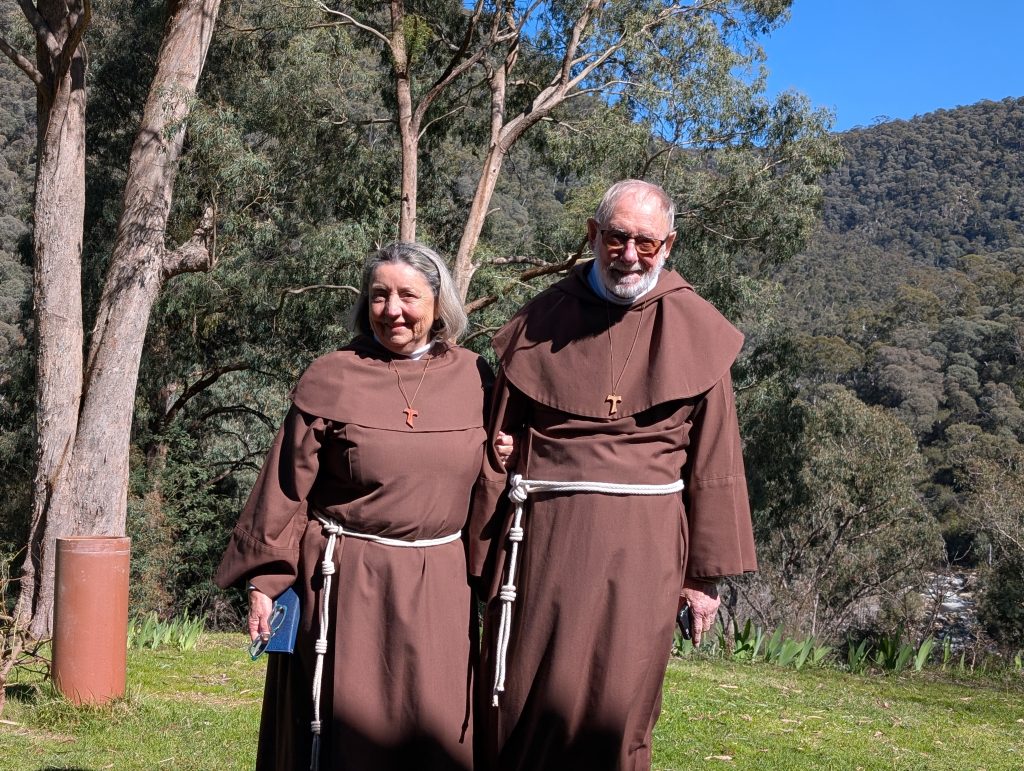
Sr Laurel and Br Edwin. Photo by Angela Young.
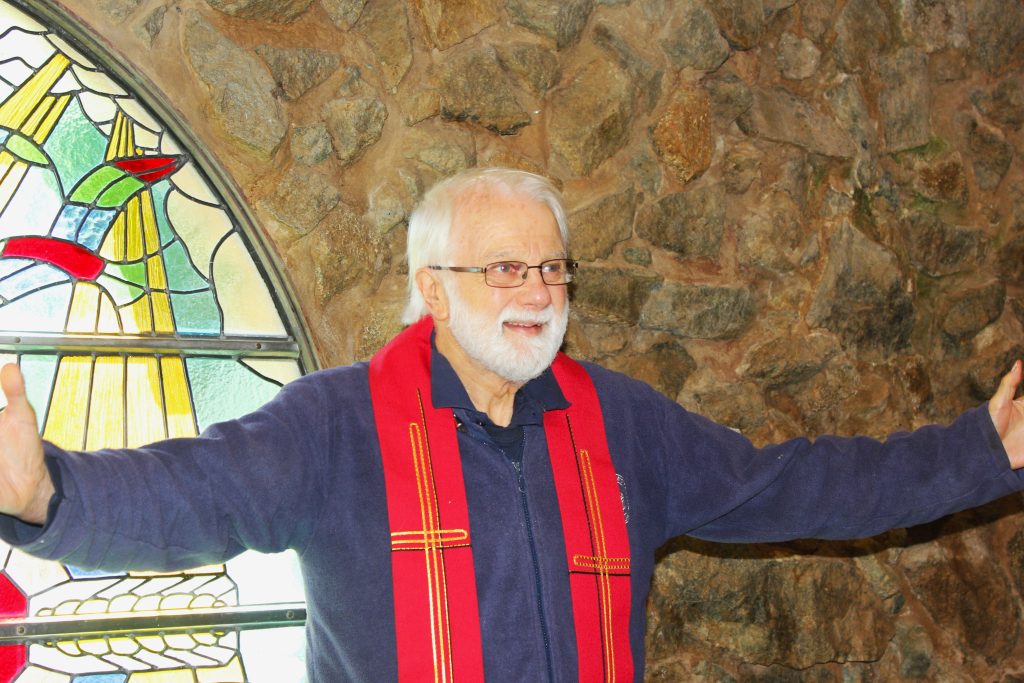
Our EGS Director Rev. Dr David Oliphant offers the blessing at the end of the service. Photo by Blair Montague-Drake.
I believe that in the future, new, younger and committed energies will appear to support Sarah and Pete with the ‘Greater Vision’ for the Sanctuary at Elm Grove. It will continue to unfold, enabling it to flow on like the Goobarragandra and Bahloo Rivers with their ebbs and flows and even floods at times. I believe that ‘wherever it flows that life will abound’.
Pax et bonum
Sister Laurel Clare lfsf